







Urban soils
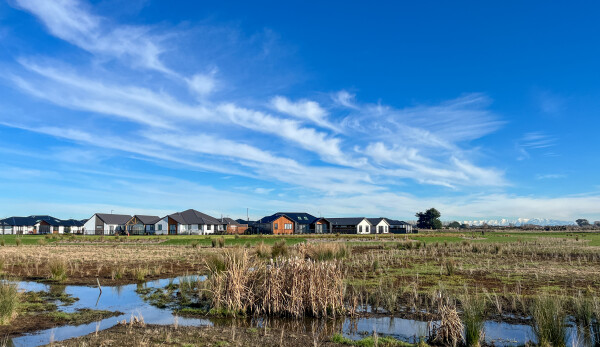
Soils are the foundation of our urban environments but are rarely recognised for their multiple critical roles in climate regulation, flood control, local food production and connection of people to nature.
Urban soils are unique because they are often profoundly altered by human activity, resulting in distinct physical, chemical, and biological properties that differ significantly from natural soils. Their primary defining characteristics include extreme spatial variability, compaction, addition of soils and amendments that are unrelated to the original soils (e.g. pumice, biochar, or scoria for drainage), contamination with human-made materials, and modified nutrient cycles.
Urban soils mitigate stormwater flows, provide food, and facilitate shade provision and temperature moderation by allowing trees to grow. There are many reasons we should value our urban soils.
Urban soils are critical to supporting human health and wellbeing, both indirectly by supporting vegetation (especially trees) and directly, including by influencing the human microbiome. The role of urban soils is gaining greater attention internationally with World Soil Day 2025 having the theme “Healthy Soils for Healthy Cities".
Beneficial functions of urban soils
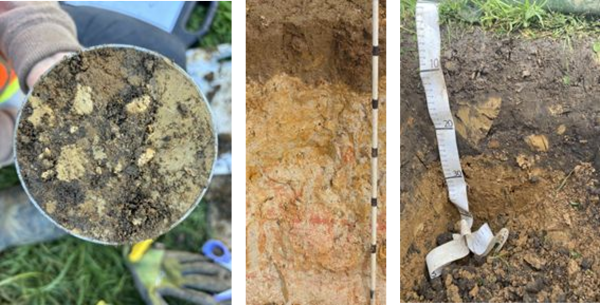
Typical features of Anthropic Soils include mixing of subsoil clods into topsoils (left and right) and very sharp boundaries between topsoil and subsoils, with truncated A / C profiles common in sites that have been cut to create terraces.
Urban soils provide a wide variety of essential ecosystem services that are vital for the sustainability and livability of cities. These functions help regulate the urban environment, support life, and provide a foundation for human activity.
The beneficial functions of urban soils include:
- Water Regulation and Flood Mitigation
- Climate Change Mitigation and Regulation
- Pollutant Filtration and Detoxification
- Support for Biodiversity and Habitats
- Support for Vegetation and Food Production
- Physical Support
- Cultural Support
- Human Health and Well-being
To take advantage of these functions, communities are implementing green infrastructure practices, such as rain gardens and using compost amendments, to improve the health and functionality of degraded urban soils.

Threats to urban soils
 Just like any other soil, urban soils have many beneficial properties, and we rely on them for a myriad of purposes, including flood protection, food production, shade provision, and recreation.
It's often forgotten that urban soils exist, including in soil quality monitoring and research. Urban soils are incredibly undervalued, in fact, people often pay to dump them in landfill - despite their vital role in environmental services.
Urban soils face multiple threats, including soil sealing, soil disposal, and contamination.
Relevant topics and projects
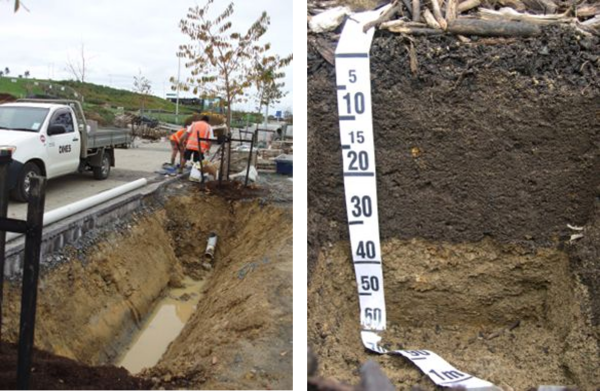
A trench excavated in a terraced residential subdivision will be filled with high-permeability raingarden media to treat road runoff; both raingardens and tree pits are artificially drained as adjacent earthworked soils have poor drainage (left). An unusual raingarden profile (right) at Tamaki, Auckland uses deep Allophanic topsoils from Waikato over basic subsoils salvaged from a North Auckland limestone quarry.
Manaaki Whenua – Landcare Research has extensive experience in urban soils. Our research focuses on understanding and mitigating the impacts of urban development on soil functions and promoting sustainable urban planning.
Key areas of our work include:
- Management of soil contaminants. We developed nationally used soil guideline values to protect soil biota, and provide guidance to councils and practitioners for the management of soil contaminants in urban settings.
- Hydrological properties: Impact of how modern "cut/fill" developments impact on soil water storage and permeability.
- Policy and guidance: Our findings inform policy discussions, including a report by the Parliamentary Commissioner for the Environment that called for greater protections for urban soil to safeguard vital environmental services. We have also developed the first-ever New Zealand guide for managing "surplus" or excavated soil and sediments, promoting a circular economy approach.
- Urban ecology and design: Our work extends to urban ecology, developing approaches to integrate indigenous nature and biodiversity into urban design, including trials with green roofs and biodiverse subdivisions.
- Data and mapping: We provide soil information and mapping data (S-map Online) used by councils and stakeholders for better land-use planning and decision-making, covering a range of land uses including 'peri-urban' and urban areas.
Our work emphasizes that soils are a critical part of nature-based solutions for urban challenges like stormwater management and climate change resilience.
Current projects include:
Realising the value of urban soils, which seeks to maximise the potential of urban soils to contribute to climate regulation, flood control, local food production and connection of people with nature by demonstrating and providing guidance on approaches for regenerating degraded soils. We will draw on previous projects and ongoing connections with commercial and iwi partners to identify key requirements to effect improvements in urban soil quality, developing a guide to regenerating urban soils, incorporating Te Ao Māori perspectives.
We are also part of the Future Urban Industry team led by University of Auckland that is investigating how future urban industrial zones (UIZs) can be designed to integrate resource-efficient economic principles, ecologically-sustainable technologies, and inclusive practices to drive economic, environmental, and social resilience whilst adapting to increasingly uncertain futures.
Future Urban Industry: integrating economic, built and ecological systems for resilient cities | Future Cities Research Centre